Showing posts with label Earth. Show all posts

Friday, July 22, 2011

Columnist Opeyemi Parham on Return of Shuttle Atlantis

Space Shuttle AtlantisImage via Wikipedia


Atlantis: End of an Era

      Being a sci-fi child was unusual, in my family African-American  artistic family. My scientific temperament made me feel the black sheep much of the time.
     My geeky tendencies were nurtured outside of my family from an early age.  Max, my third grade science teacher introduced me to atomic theory. I saw a standard drawing of a nucleus, a proton and an electron  and had an epiphany. It represented EVERYTHING. Finding the language of math and science to explore this way of seeing the world was a given for me, from that day onward.
     Then there was  "A Wrinkle in Time", read aloud by my fourth grade teacher. This mythopoetic story of Meg (clumsy misfit struggling to find her place in the world, suddenly transported  into a great struggle to save Earth from Dark Forces) prepared me to believe in miracles, and in the power of love.
     It is with very mixed feelings that I have witnessed the end of America's space program. The return of the  shuttle Atlantis on July 21-- the same day "we" walked on the moon--IS the end of an era. It was an era that started on the wrong foot. A race AGAINST the Russians. The planting of a flag, CLAIMING the moon for "us".    
     A poem I wrote in 9th grade still reads true, all these many years later:

                               "I once heard a Navajo woman,
                                who was withered, 
                                Like the last leaf of Autumn
                                Say, 
                               Upon hearing that man had reached the moon,
                               Very quietly,
                                Very softly,
                              'I don't think that man was meant to go to the moon'
                               And I knew that when she died
                               A small piece of humanity would die with her.
                               Because she still saw the moon
                               As luminous power  in a night sky,
                                As a Goddess, to be respected--
                               Not a rock on which to plant a flag
                               Or a dumpsite for discarded LEMs."

      Could the millions spent on the space program have been  better utilized? What were we humans exporting, anyway? How could we simply leave all our junk up there out in space? Was space becoming the new "away" for throwing things away?
     About two weeks ago, I was having a conversation with my geeky MIT grad buddy, the product of parents who are both engineers who work for NASA. His defense of a continued need for the space program boiled down to "having somewhere to do the dangerous experiments".
     Hmmm.
     Like exploding nuclear bombs? Or biologic warfare tests?
     It was not until 1992 that anyone looking like me went into space. Mae Jemison was a dancer, and a doctor, as well as an astronaut. She resigned from NASA in 1993. In 1996, she filed a police brutality report against a Texas police officer, following her arrest for a traffic violation.
      That incident alone enforces my belief that we have a lot more work to do  "down here" before our government gets back to space exploration.
     We'll get there; in the right time in the right way.
    With the REAL Right Stuff next time.

--
                       Opeyemi  413-336-1291
                        P.O. Box 264
                        Hadley, MA. 01035  (www.ceremonyheals.com)
         check out my essay in Hope Beneath Our Feet: Restoring Our Place in the Natural World   http://www.hopebeneathourfeet.com  and my CHAPTER in Dancing on the Earth http://www.dancingontheearth.ca./ 
                                                         

Enhanced by Zemanta

Wednesday, December 1, 2010

Geoengineering Is a Recipe for Disaster

Marian Koshland Science Museum of the National...Image via Wikipedia

Geoengineering Is a Recipe for Disaster

This Climate Plan B approach could cause wars and mass starvation.

by Diana Bronson
Think you've heard enough about climate change? Chances are you haven't heard anything about the dangerous and costly sci-fi climate fixes known as geoengineering.
Geo-what? Geoengineering is a set of speculative, massive-scale technologies that would have humans intentionally modify the climate--rather than accidentally, as we've been doing since the Industrial Revolution. Many U.S. lawmakers are starting to take it seriously as a climate change Plan B.
Yet, proposed geoengineering schemes are absurd and potentially devastating for the Earth.
Here are a few examples of how you could make the Earth cooler by "managing solar radiation" (i.e. manipulating the sun):
  • Put trillions of tiny mirrors between Earth and sun to reflect sunlight back to space.
  • Whiten the clouds over our oceans by increasing the droplet size, making the Earth more reflective.
  • Blast sulphate particles into the stratosphere to simulate volcanic eruptions, again to block sunlight and diminish warming.
Then there are technologies under development to actually suck carbon out of the atmosphere and bury it, either:
  • In oceans through growing algae, which feeds on CO₂, or
  • On highways, by lining them with giant synthetic trees (which use chemical processes to suck CO₂ out of the air).
Yeah, right.
You'd think that only mad scientists could conjure up these schemes. That may be true with some of them. But in a world where carbon--whose excess is causing the climate to change in ways that endanger human health--has become a tradable commodity, there's money to be made out of contrived carbon business ventures.
Neither national laws nor international negotiations are making much progress to halt the accumulation of atmospheric carbon. Technophiles are taking advantage of that void by promoting their own schemes.
Logically, since these schemes will cost incalculable billions of dollars, there's a geoengineering lobby comprised of scientists, engineers, entrepreneurs. It includes a few eminent scientists like geochemist Ken Caldeira and businessmen like Richard Branson. This lobby is seizing the moment, loudly proclaiming that there's no alternative and that they're only coming up with these proposals out of their duty to save the world.
Their ideas are nuts, but prestigious science academies, the media, and Congress are listening to them.
Several reports examining geoengineering options have been published in London and Washington over the past year. Congress has held hearings. The Government Accountability Office has called for a coordinated federal strategy. Bill Gates is funding research. The National Academy of Sciences is devoting attention to it and scientists are looking at "voluntary standards" for tampering with the climate.
Experts expect the federal government to announce plans to spend much more money on geoengineering research.
Ironically, some of geoengineering's most ardent advocates are best known for their arguments against climate action, including outfits like the American Enterprise Institute and individuals like Bjørn Lomborg of Denmark. Somehow they're now urgently calling for a massive techno-fix for a problem they have spent their careers saying is exaggerated.
Fortunately, a few cooler heads are prevailing. The pace at which these technologies were being pushed to the fore so alarmed participants at a UN meeting in Japan in October, that the 193 countries present adopted a moratorium on geoengineering experiments.
The world's governments, which had convened to discuss the alarming decline of natural biodiversity, rightly saw geoengineering's potential for ecological disaster.
They saw the possibility of these harebrained schemes destroying the oceans, disturbing weather patterns, concentrating unprecedented power to control the Earth's thermostat in a very small number of hands, and the possibility of unilateral deployment of unsafe technologies.
Geoengineering's potential political fallout could include war, mass starvation, and an inability to ever "switch off" the technological systems these crazy operations would deploy. Plus, think of the chaos that would result if our ecosystems never returned to anything close to their natural state.
Of course, we can't even predict the most serious consequences because we don't even fully understand the complex climate system geoengineers propose to manipulate.
Our planet's health is at stake. Geoengineering is a reckless gamble we can't afford.
Diana Bronson is a Montreal-based program manager with ETC Group, an international NGO which monitors new technologies.
Enhanced by Zemanta

Sunday, July 25, 2010

Despite Spending Millions Lobbying, Nuke Industry Losing.

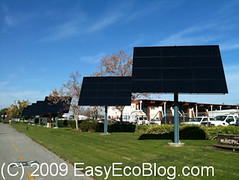
Easy-Eco-Blog-Solar-Panels-Solar-PowerImage by EasyEcoBlog via Flickr

Why Stewart Brand is Wrong on Nukes - and is Losing

Stewart Brand has become a poster boy for a "nuclear renaissance" that has just suffered a quiet but stunning defeat. Despite $645 million spent in lobbying over the past decade, the reactor industry has thus far failed to gouge out major new taxpayer funding for new commercial reactors.
In an exceedingly complex series of twists and turns, no legislation now pending in Congress contains firm commitments to the tens of billions reactor builders have been demanding. They could still come by the end of the session. But the radioactive cake walk many expected the industry to take through the budget process has thus far failed to happen.
The full story is excruciatingly complicated. But the core reasons are simple: atomic power can't compete, and makes global warming worse.
In support of this failed 20th Century technology, the industry has enlisted a 20th Century retro-hero, Stewart Brand. Back in the 1960s Brand published the Whole Earth Catalog. Four decades later, that cachet has brought him media access for his advocacy of corporate technologies like genetically modified foods and geo-engineering.....and, of course, nuclear energy.
In response to a cover interview in Marin County's Pacific Sun, I wrote the following to explain why Stewart is wrong wrong wrong:
    Stewart Brand now seems to equate "science" with a tragic and dangerous corporate agenda. The technologies for which he argues--nuclear power, "clean" coal, genetically modified crops, etc.--can be very profitable for big corporations, but carry huge risks for the rest of us. In too many instances, tangible damage has already been done, and more is clearly threatened. If there is a warning light for what Stewart advocates, it is the Deepwater Horizon disaster, which much of the oil industry said (like Three Mile Island and Chernobyl) was "impossible." Then it happened. The $75 million liability limit protecting BP should be ample warning that any technology with a legal liability limit (like nuclear power) cannot be tolerated. Thankfully, there is good news: We have true green alternatives to these failed 20th-century ideas. They're cheaper, safer, cleaner, more reliable and more job-producing than the old ways Stewart advocates. Stewart and I have never met. But we have debated on the radio and online. Thank you, Pacific Sun, for bringing us to print. Stewart's advocacy does fit a pattern. He appears to have become a paladin for large-scale corporate technologies that may be highly profitable to CEOs and shareholders, but are beyond the control of the average citizen, and work to our detriment. Because he makes so many simple but costly errors, let's try a laundry list: 1. Like other reactor advocates, Stewart cavalierly dismisses the nuclear waste problem by advocating, among other things, the stuff be simply dumped down a deep hole. This is a terribly dangerous idea and will not happen. Suffice it to say that after a half-century of promises (the first commercial reactor opened in Pennsylvania in 1957) the solution now being offered by government and industry is...a committee!!! Meanwhile, more than 60,000 tons of uniquely lethal spent fuel rods sit at some 65 sites in 31 states with nowhere to go. Like the reactors themselves, they are vulnerable to cooling failure, terror attack, water shortages, overheating of lakes, rivers and oceans, flooding, earthquakes, tornadoes and hurricanes, and much more. This is no legacy to leave our children. 2. Equally disturbing is the industry's inability to get meaningful private liability insurance. The current federally imposed limit is $11 billion, which would disappear in a meltdown even faster than BP's $75 million in the Gulf. According to the latest compendium of studies, issued this spring by the New York Annals of Science, Chernobyl has killed some 985,000 people, and is by no means finished. It has done at least a half-trillion dollars in damage. The uninsured death toll and financial costs of a similar-scaled accident in the U.S. are incalculable, but would clearly kill millions and bankrupt our nation for the foreseeable future. 3. Stewart points out that there are also risks with wind and solar power. But clearly none that begin to compare with nukes, coal or deep-water drilling. If reactor owners were forced to find reasonable liability insurance, all would shut. A similar demand for renewables and efficiency would leave them unaffected. 4. Renewable/efficiency technologies today are cheaper, faster to deploy and more job-creating than nukes. It takes a minimum of five years to license and build a new reactor. The one being done by AREVA in Finland is hugely over budget and behind schedule. There is no reason to expect anything better here. Among other things, the long lead time ties up for too many years the critical social capital that could otherwise go to technology that can quickly let the planet heal. 5. Like others who doubt the possibility of a green-powered Earth, Stewart posits the straw man of reliance on a deployment of solar panels that would blanket the desert and do ecological harm. In fact, the National Renewable Energy Lab estimates 100 percent of the nation's electricity could come from an area 90 miles on a side, or a relatively modest box of 8,100 square miles. But as we all know, that's not how it will be done. Solar panels belong on rooftops, where there is ample area throughout the nation, and an end to transmission costs. Likewise, wind farms do not "cover" endless acres of prairie, their tower bases take up tiny spots that remain surrounded by productive farmland. In this case, currently available wind turbines spinning between the Mississippi and the Rockies could generate 300 percent of the nation's electricity. There's sufficient potential in North Dakota, Kansas and Texas alone to do 100 percent. Cost and installation times put nukes to shame. The liability is nil, as is the bird kill, which primarily affects obsolete, badly sited fast-spinning machines in places like Altamont Pass. Those must come down, and there will certainly be other surprises along the way. No technology is perfect, and we need to be careful even with those that are green-based. But as we have seen, further threats on the scale of Chernobyl and the Deepwater Horizon cannot be sustained. 6. As for GMO crops, Darwin was right. Plants evolve to avoid herbicides just as bugs work their way around pesticides (which Stewart correctly decries). Now we see that "super-weeds" are outsmarting the carefully engineered herbicides meant to justify the whole GMO scheme, bringing a disastrous reversion to horrific, lethal old sprays. Chemical farming may be good for corporate profits, but it can kill global sustainability. In the long run, only organics can sustain us. 7. Stewart mentions that he is paid only for speeches. But a single such fee can outstrip an entire year's pay for a grassroots organizer or volunteer. What's remarkable is that the nuclear power industry spent some $645 million lobbying for its "renaissance" over the past decade--more than $64 million/year. It has bought an army of corporate lobbyists and legislators. Yet only a handful of folks with rear guard environmental credentials has stepped forward to fight for the old fossil/nuclear/GMO technologies. 
Stewart is certainly welcome to his own opinions. But not to his own facts. Pushing for a nuclear "renaissance" concedes that it's a Dark Age technology, defined by unsustainable costs, inefficiencies, danger, eco-destruction, radiation releases, lack of insurance, uncertain decommissioning costs, vulnerability to terrorism and much more.
That the industry must desperately seek taxpayer help, and cannot find insurance for even this "newer, safer" generation, is the ultimate testimony to its failure. By contrast, renewables and efficiency are booming, and are a practical solution to our energy needs, which the corporate clunkers of the previous century simply cannot provide.
It's been a long time since the Whole Earth Catalog was published. Its hallowed founder should wake up to the booming holistic green technologies that are poised to save the Earth. They are ready to roll over the obsolete corporate boondoggles that are killing Her. Chernobyl, Three Mile Island, the disasters in the coal mines and the Gulf remind us we need to make that green-powered transition as fast as we possibly can.
Harvey Wasserman's SOLARTOPIA! OUR GREEN-POWERED EARTH, A.D. 2030, is at www.solartopia.org. He is senior advisor to Greenpeace USA and the Nuclear Information & Resource Service, and writes regularly for www.freepress.org.
Enhanced by Zemanta

Sunday, April 18, 2010

I Believe by Samir Doshi

The helix of sustainability - minimum environm...Image via Wikipedia

Published on Sunday, April 18, 2010 by Burlington Free Press (Vermont)
I Believe.

by Samir Doshi

Advocates of the sustainability movement envision a future where our global society evolves toward a culture of environmental protection, social equity, democratic participation and representation, and an economy that is predicated on the Earth as the source of capital instead of just another resource.

Unfortunately, many do not see a worldwide transition toward a sustainable and desirable future without a catastrophic event that awakens people to transition past the current direction of the status quo. The thought being that unless we are on the brink of a collapse, our society as a whole will not act, as our priorities lie elsewhere.

Author Bill McKibben and climatologist James Hansen feel we already are at a "tipping point" in regard to our impact on the climate, and if we do not decrease the current level of carbon dioxide in our atmosphere, we will witness large-scale environmental and societal consequences in the coming decades.

In his book "Revenge of Gaia," renowned scientist James Lovelock states that we have 10 years to act to avoid a large collapse, but we already are past certain tipping points, and some consequences cannot be avoided. The attempts to convey this urgency have had some results at the governmental level, but rates of soil erosion, deforestation, hunger, carbon emissions, biodiversity loss and poverty continue to rise. Sure, there are numerous initiatives and organizations that are operating at a local level to help foster this transition, but haven't we seen similar efforts during the past decades while still increasing our overall impact?

There are numerous examples to show the level of participation and attention toward these issues is larger than ever before.

Last October, McKibben and his advocacy group 350.org helped to organize the largest worldwide environmental rally to support action to reduce our carbon footprint - more than 5,200 events in 181 countries came out in full force.

In another laudable effort, Elinor Ostrom won the 2009 Nobel Prize in economics for examining the role that common-pool resources have in bringing stakeholders together to work toward sustainable and equitable solutions for all parties involved. Ostrom's research re-examines Garret Hardin's "Tragedy of the Commons," a widely referenced theory contending that population growth and individual selfishness take precedence over long-term interests of social and environmental welfare.

Paul Hakwen's recent book, "Blessed Unrest," documents how the world's largest movement of more than a million organizations emerged without any unified leader or common cause and ultimately can benefit environmental health and social equity.

Nevertheless, according to the latest Pew and Gallup polls, we see sustainable transitions take a back seat to economic development and growth, and in the U.S., national security. Again, it seems that only a catastrophic event can cause people to understand the link between the current ecological, social, and economic recessions. Neither Hurricane Katrina nor any of the recent widespread heat waves or droughts has inspired national collective and public action toward reducing natural-resource mismanagement.

Is a larger and more-devastating event needed to spur action? What about something on the order of the fantastical and unrealistic apocalyptic movie "The Day After Tomorrow," where climate change causes an overnight ice age?

Perhaps we should alter our strategy. What if we could choose hope rather than despair to instill the will for a transformation? Instead of a debilitating phenomenon, could we create something phenomenal that could inspire people so that a transformation is not only possible, but it is desirable? Remarkable and powerful initiatives are happening today that affect such grand scales they seem to be unrealistic. I believe we can realize the impossible, and it can catalyze action at a global level that will lead to a sustainable transformation.

The best example of achieving the impossible is forestry scientist Willie Smits' work in Borneo. Smits founded the Borneo Orangutan Survival Foundation (BOS) in 1991 and set out to protect orangutans that were losing their rainforest habitat in Borneo to huge levels of deforestation to develop palm plantations for biofuel oil. Smits thought that in order to save the ape species from extinction, he would have to restore their habitat.

In fewer than five years, BOS transformed 5,000 acres of degraded and lifeless tropical wasteland into a regenerated rainforest with more than 1,000 indigenous tree species, 100 native bird species, 25 percent more rainfall and 3,000 new jobs that use the sap from the native sugar palm to develop new products.

Amory Lovins, founder of the Rocky Mountain Institute, has called Smits' efforts the "finest example of ecological and economic restoration in the tropics."

Similar efforts have been occurring in New England for many years. Nearly 30 years ago, biologist and ecological designer John Todd looked at the role of vegetation and aquatic microorganisms in breaking down wastes and producing beneficial products. The research progressed into the founding of the Eco-Machine, a technology that has been used to treat human and industrial wastewater and also paved the way for the field of biomimicry. There are over 100 different Eco-Machines treating waste in numerous countries worldwide.

Along with several organizations in New England and in the Southeast, I am working toward developing similar stories in the Appalachian coal fields. Through the single-resource dependency of coal and mountaintop-removal surface mining, Appalachian communities suffer some of the highest levels of environmental degradation, poverty, infant mortality, heart disease and high-school dropout rates in the country.

It is incredible this is occurring in the most biologically diverse temperate forest system in the world, and one of the most culturally storied regions in our country. More than a million acres, 1,200 miles of streams and 450 mountains have been blown up - the tonnage of explosives used in two weeks to remove mountaintops in Appalachia is equivalent to one of the atomic bombs dropped on Japan in World War II. The coal fields have been labeled appropriately as America's "sacrifice zone" in order to perpetuate our addiction to coal.

While we need to stop the removal of mountains, we also need to help transition the area toward a more-diversified and resilient economy. In collaboration with universities and nonprofit organizations, we are researching how to regenerate the mined landscapes to develop native ecosystems that can support an industrial ecology of locally produced carbon-negative biofuel feedstocks, biochar and Agro-Eco-Park developments.

We are also working with newly established enterprises on agroforestry, sustainable agriculture and renewable-energy developments. As a partner in the Appalachian Transition Initiative headed up by David Orr and Bill Becker, we are working with local communities to transition their ecology and economy toward a resilient infrastructure, something many community members previously thought was impossible - but now feel is inevitable.

Similar to what Smits said of Borneo, Orr has stated Appalachia can be the proving ground for degraded rural landscapes all over the world: "If we can do it here," he says, "we can do it anywhere."
Copyright ©2010 Burlington Free Press
Samir Doshi is a doctoral candidate at the University of Vermont's Gund Institute and Rubenstein School for Environment and Natural Resources. His research explores the role that ecological design can play in the relationship between natural and social communities in Appalachia. He has worked as a farmer in New Zealand, developed water conservation projects in Fiji, helped establish and taught in a nonprofit school in India and even was a dishwasher for the 14th Dalai Lama. Contact Samir Doshi at Samir.Doshi@uvm.edu.

Reblog this post [with Zemanta]

Tuesday, November 3, 2009

Global Warming and Greenfield

The geographic distribution of surface warming...Image via Wikipedia
 Forward by Drew Hutchison


What I find so absurd about the support given to the proposed bio-mass plant in Greenfield is that it is contraindicated by global events. The amount of CO2 emissions from the plant will be greater per ton than the present coal fired plant in Holyoke. While I respect that our forests are a great resource that are underutilized commercially, they do a great job of sequestering excess carbon. Sustainable harvesting may be possible, but what cannot be denied is that the rate of carbon emitted will enter our atmosphere immediately and exacerbate a severe climate crisis.
We may have already reached the tipping point where our efforts to halt wide spread environmental catastrophe are in vain. Greenfield can be ahead of the curve in being proactive about energy usage and fostering environmentally friendly employment. Unfortunately, pro business ideology or ignorance seems to have blinded some to the inherent flaws in the proposed plant. I applaud Mayor Martin for his tireless efforts to help Greenfield move forward. We need his energy and leadership during these times of fiscal crisis. Building the bio-mass plant in my view will possibly help the coffers in the short term. It will likely be a hulking dinosaur within a decade, mothballed because politics will eventually catch up with what the science has clearly been telling us for some time. In order to avert this blunder, I personally hope the plant is not built, but if it is, it should be fitted to also run on natural gas.


Published on Tuesday, November 3, 2009 by The Guardian/UK

Climate Change Deniers Are Not Skeptics - They're Suckers

My fiercest opponents on global warming tend to be in their 60s and 70s. This offers a fascinating, if chilling, insight into human psychology

by George Monbiot
There is no point in denying it: we're losing. Climate change denial is spreading like a contagious disease. It exists in a sphere that cannot be reached by evidence or reasoned argument; any attempt to draw attention to scientific findings is greeted with furious invective. This sphere is expanding with astonishing speed.
A survey last month by the Pew Research Centre suggests that the proportion of Americans who believe there is solid evidence that the world has been warming over the last few decades has fallen from 71% to 57% in just 18 months. Another survey, conducted in January by Rasmussen Reports, suggests that, due to a sharp rise since 2006, US voters who believe global warming has natural causes (44%) outnumber those who believe it is the result of human action (41%).
A study by the website Desmogblog shows that the number of internet pages proposing that man-made global warming is a hoax or a lie more than doubled last year. The Science Museum's Prove it! exhibition asks online readers to endorse or reject a statement that they've seen the evidence and want governments to take action. As of yesterday afternoon, 1,006 people had endorsed it and 6,110 had rejected it. On Amazon.co.uk, books championing climate change denial are currently ranked at 1, 2, 4, 5, 7 and 8 in the global warming category. Never mind that they've been torn to shreds by scientists and reviewers, they are beating the scientific books by miles. What is going on?
It certainly doesn't reflect the state of the science, which has hardened dramatically over the past two years. If you don't believe me, open any recent edition of Science or Nature or any peer-reviewed journal specialising in atmospheric or environmental science. Go on, try it. The debate about global warming that's raging on the internet and in the rightwing press does not reflect any such debate in the scientific journals.
An American scientist I know suggests that these books and websites cater to a new literary market: people with room-temperature IQs. He didn't say whether he meant fahrenheit or centigrade. But this can't be the whole story. Plenty of intelligent people have also declared themselves sceptics.
One such is the critic Clive James. You could accuse him of purveying trite received wisdom, but not of being dumb. On Radio 4 a few days ago he delivered an essay about the importance of scepticism, during which he maintained that "the number of scientists who voice scepticism [about climate change] has lately been increasing". He presented no evidence to support this statement and, as far as I can tell, none exists. But he used this contention to argue that "either side might well be right, but I think that if you have a division on that scale, you can't call it a consensus. Nobody can meaningfully say that the science is in."
Had he bothered to take a look at the quality of the evidence on either side of this media debate, and the nature of the opposing armies – climate scientists on one side, rightwing bloggers on the other – he too might have realised that the science is in. In, at any rate, to the extent that science can ever be, which is to say that the evidence for man-made global warming is as strong as the evidence for Darwinian evolution, or for the link between smoking and lung cancer. I am constantly struck by the way in which people like James, who proclaim themselves sceptics, will believe any old claptrap that suits their views. Their position was perfectly summarised by a supporter of Ian Plimer (author of a marvellous concatenation of gibberish called Heaven and Earth), commenting on a recent article in the Spectator: "Whether Plimer is a charlatan or not, he speaks for many of us." These people aren't sceptics; they're suckers.
Such beliefs seem to be strongly influenced by age. The Pew report found that people over 65 are much more likely than the rest of the population to deny that there is solid evidence that the earth is warming, that it's caused by humans, or that it's a serious problem. This chimes with my own experience. Almost all my fiercest arguments over climate change, both in print and in person, have been with people in their 60s or 70s. Why might this be?
There are some obvious answers: they won't be around to see the results; they were brought up in a period of technological optimism; they feel entitled, having worked all their lives, to fly or cruise to wherever they wish. But there might also be a less intuitive reason, which shines a light into a fascinating corner of human psychology.
In 1973 the cultural anthropologist Ernest Becker proposed that the fear of death drives us to protect ourselves with "vital lies" or "the armour of character". We defend ourselves from the ultimate terror by engaging in immortality projects, which boost our self-esteem and grant us meaning that extends beyond death. More than 300 studies conducted in 15 countries appear to confirm Becker's thesis. When people are confronted with images or words or questions that remind them of death they respond by shoring up their worldview, rejecting people and ideas that threaten it, and increasing their striving for self-esteem.
One of the most arresting findings is that immortality projects can bring death closer. In seeking to defend the symbolic, heroic self that we create to suppress thoughts of death, we might expose the physical self to greater danger. For example, researchers at Bar-Ilan University in Israel found that people who reported that driving boosted their self-esteem drove faster and took greater risks after they had been exposed to reminders of death.
A recent paper by the biologist Janis L Dickinson, published in the journal Ecology and Society, proposes that constant news and discussion about global warming makes it difficult to repress thoughts of death, and that people might respond to the terrifying prospect of climate breakdown in ways that strengthen their character armour but diminish our chances of survival. There is already experimental evidence that some people respond to reminders of death by increasing consumption. Dickinson proposes that growing evidence of climate change might boost this tendency, as well as raising antagonism towards scientists and environmentalists. Our message, after all, presents a lethal threat to the central immortality project of western society: perpetual economic growth, supported by an ideology of entitlement and exceptionalism.
If Dickinson is correct, is it fanciful to suppose that those who are closer to the end of their lives might react more strongly against reminders of death? I haven't been able to find any experiments testing this proposition, but it is surely worth investigating. And could it be that the rapid growth of climate change denial over the last two years is actually a response to the hardening of scientific evidence? If so, how the hell do we confront it?
George Monbiot is the author of the best selling books The Age of Consent: a manifesto for a new world order and Captive State: the corporate takeover of Britain. He writes a weekly column for the Guardian newspaper. Visit his website at
Reblog this post [with Zemanta]