Showing posts with label Washington. Show all posts

Thursday, October 7, 2010

Economics 101 for Deficit Hawks

Portrait of Dean BakerImage via Wikipedia

Economics 101 for Deficit Hawks

The same Washington policymakers who inveigh against the deficit want a strong dollar – clueless about the contradiction

There are few areas of economics more boring than accounting identities. This is really unfortunate, since it is virtually impossible to have a clear understanding of economic policy without a solid knowledge of the underlying identities.
Most of the people in Washington policy debates were apparently overcome by boredom before they could get this knowledge. As a result, we see some really silly policy debates.
The debate over the value of the dollar against the Chinese yuan is the latest episode in this silliness. The Washington tribal elite has been on the warpath against budget deficits in recent months. They have worked themselves into such a frenzy that nothing will stand in their way: neither concerns about unemployment, nor concerns about the well being of our elderly, nor even concerns about basic economic logic.
The central problem stems from the simple accounting identity that national savings is equal to the broadly measured trade surplus. A country with a large trade surplus will also have large national savings. Conversely, a country with a large trade deficit will have negative national savings. These relationships are accounting identities – there is no way around them.
This brings us to the next part of the story; where trade deficits come from. At a given level of GDP, the main determinant of the trade deficit is the value of the dollar in international currency markets. This is very basic supply and demand. If the dollar is higher in value relative to other currencies, then our exports will cost more to people living in Germany, Japan, and China.
If a car sells for $20,000 in the United States, then the price of this car to people living in other countries will depend on how much of their own currency (euros, yen or yuan) they must pay to get a dollar. The higher the dollar relative to these other currencies, the more expensive the car is to foreigners. And, the more expensive it is to foreigners, the fewer US-made cars they will buy. This means our exports will fall.
The story works in reverse on the import side. If the dollar is high and therefore buys lots of foreign currency, then imports are cheap. This means that we will buy lots of imports.
If we have low exports and high imports, then we will have a large trade deficit. End of story. We can train our workers to be more productive, urge our firms to invest more and try to improve our public infrastructure, but realistically, none of these factors can come close to offsetting the impact of a currency that is 20-40% over-valued. A severely over-valued currency virtually guarantees a trade deficit.
This brings us back to the budget deficit part of the story. If the United States has a large trade deficit, then it means that net national savings are negative. That is definitional. For net national savings to be negative, then we must have either negative private savings or negative public savings (that is, a budget deficit).
During the peak years of the housing bubble, private savings were strongly negative. This was because the wealth created by the bubble led homeowners to spend rather than save. With the collapse of the housing bubble, people are now saving much more. Furthermore, investment has fallen due to overbuilding, which means that private-sector savings are no longer negative.
This leaves us with our large budget deficit. The budget deficit follows from the fact that we have a trade deficit, which is, in turn, the result of the over-valued dollar. This brings us to the strangely paradoxical behavior of the Washington policy elite.
Many of the same people who routinely express horror over the size of the budget deficit were either on the sidelines or in actual opposition to the effort by congress to get China to raise the value of its currency against the dollar. While one can argue as to whether the bill approved by the house of representatives was the best route to go, anyone who hopes to get the trade deficit down must recognize the need to lower the value of the dollar. And, if one wants to get the budget deficit down, then it is necessary to reduce the trade deficit.
This raises the possibility that perhaps the deficit hawks don't really give a damn about the deficit. Perhaps the deficit hawks just want to cut social security and Medicare and other programmes that benefit the middle class and moderate-income people.
Of course, it is also possible that the deficit hawks are just confused when it comes to economic policy. It's hard to know for sure. But these days, ignorance and/or dishonesty appear to be the chief qualifications for entry to Washington policy debates.
Dean Baker is co-director of the Center for Economic and Policy Research
Enhanced by Zemanta

Tuesday, August 31, 2010

Glen Beck Lacks Honor


David Weidner's Writing on the Wall
David Weidner
Aug. 31, 2010, 12:01 a.m. EDT

Glenn and me

Commentary: A Talking Heads moment with the controversial talk show host

By David Weidner, MarketWatch
NEW YORK (MarketWatch) -- Glenn Beck welcomed me with a big hello and a goofy grin. I liked him immediately.
It was April Fool's Day 2008, more than two years before his day in the Washington sun this past weekend. Bear Stearns Cos. had just been acquired by J.P. Morgan Chase & Co. (NYSE:JPM) . The financial industry was spinning, but much of the world was still living in the bubble economy. Housing prices were holding. Oil prices were still north of $100 a barrel.
Earlier that day, I had been invited on his show. It was still on CNN. Beck moved to Fox News later that year. The topic was the price of oil. A producer called for a pre-interview. I had done a lot of reporting and writing on the subject. My take was that Wall Street speculation was largely to blame, not the oil companies. Read 2008 column on oil speculation.
TV commentator Glenn Beck
Reuters


TV commentator Glenn Beck waves to supporters at his Restoring Honor rally on the National Mall in Washington.
(Fox is a division of News Corp. (NASDAQ:NWS) , which also owns MarketWatch.)
Beck's producer was smart and asked good questions. I explained to her how Wall Street traders pushed up energy prices in Europe where there were fewer market limits and how Goldman Sachs Group Inc. (NYSE:GS) analysts were particularly influential in driving up prices by setting eye-popping price targets. It was a subject that had been under-covered by the media, in my opinion.
She explained to me that Beck wanted to know if oil companies were responsible. I said I didn't think so, and we made arrangements for my visit to the studio.

Made bigger by TV

At the time, I was familiar with Beck, but not a regular viewer. His billboards were ubiquitous on the sides of city buses. His interviews didn't make much of an impression on me, or at least I didn't remember anything if I saw one.
His monologues were the thing that really awed me. I didn't always agree with him -- rarely, actually -- but as someone who writes and talks commentary, I admired his skills. He's a fantastic and persuasive speaker in the way he uses cadence, pauses and nuanced words.
A radio guy at heart, Beck's transition to TV made him even more powerful. He isn't a handsome guy. He looks like your local insurance agent. But the folksy persona matches the message.

News Hub: A once-reliable gauge, P/E loses luster

Benjamin Levisohn discusses the P/E ratio, the once tried and true market measurement that's losing its luster as a way to measure a stock's value.
When I arrived at the studio, I was ushered into the makeup room and that's where I first met Beck. In person, he's not much different than what you get on the tube. He is, perhaps, a little more rumpled. He was wearing Converse sneakers. I've bumped into him a few times here in the News Corp. building. I've never seen him in a suit.

On the show

After giving me his big hello, Beck rushed off to somewhere, probably his stage. I was sent to a dark small booth with a camera pointed at a tall chair. These "remote" studios aren't that unusual. They use them to save space on the main stage, or just create the illusion that someone is beaming in. But for Beck they served a purpose I would soon discover.
There was a monitor so I could watch the show. Beck was doing his monologue. Then, he interviewed someone on a different subject. Finally, he turned to the subject of oil prices.
My memory of what followed may not be perfect. I contacted CNN to get a clip of the show and they didn't respond. It's not on YouTube, which is surprising, since it seems everything is. But my conversation with Beck left a lasting impression.
Beck introduced me. A light on the camera turned red. I smiled. The light went off. Beck didn't begin with a question, but more of a statement. He said he knew that I thought speculation was to blame. He said he knew I thought Wall Street had a role. But wasn't, Beck said, the real problem Congress?
April Fool's Day, indeed. Beck bum-rushed me by dismissing the answers I had given to his producer earlier. He turned a discussion of the causes of high oil prices into a political debate, one I wasn't really interested in or prepared to talk about.
Disoriented, I probably didn't start my reply well, but when I got my wits about me, I argued that his thesis was wrong. I said it wasn't a political issue but a trading issue. My answer probably started to sound hostile.
And here's where Beck had what we all do from time to time, a Talking Heads moment. He stopped making sense.
Beck followed up with a question -- again it was more of a statement -- about how government policy was responsible for higher oil prices. It was a theme he would return to all summer as oil prices inched higher.
Again, I said I didn't see it that way and before I could elaborate, Beck began talking over me, that little red light went off and he turned to another guest in Washington who seemed to agree with him before my audio was turned off.
It was over. Gone in 30 seconds, if that.

'Restoring honor'

I was angry and disappointed. On one level, I understood. This was his show. It was his game. It was entertainment, not a real debate. It happens. Whether CNN, CNBC, MSNBC or Fox, shows are hosted in a way in which guests are brought on to simply break up the monotony.
We're fodder for the stars. Beck wanted a guest who played into his narrative that we shouldn't blame the oil companies for high prices; we should blame the government.
But on another level I was profoundly disturbed that Beck had used a news device -- interviews -- to advance an agenda.
The price of gas is pivotal to our economy. What influences its price is complicated. Yes, there's plenty of room for debate even over whether speculators are fueling the price. But the way Beck dealt with the subject was dishonest. Ours was a mock interview, perhaps designed to be contentious and keep the viewers watching.
What it wasn't, was an intelligent discussion. It wasn't even a discussion. Perhaps I was naive, but I still can't help but feel I was duped and set up. Small consolation: I watched a few of his shows and found I wasn't the only one.
And that's why when I saw my old friend Glenn Beck leading "restoring honor" marches on Washington as he did Saturday, I wondered what kind of "honor" he's talking about. Honoring guests? Honoring ideas? Honoring points of view?
Who knows? But knowing how Beck doesn't like things complicated, I'll make an observation and keep it simple.
Restoring honor? You have to have some to begin with.

Enhanced by Zemanta

Saturday, July 10, 2010

Tax the Rich

Are Low Taxes Exacerbating the Recession?

As the planet's economy keeps stumbling, the phrase "worst recession since the Great Depression" has become the new "global war on terror" -- a term whose overuse has rendered it both meaningless and acronym-worthy. And just like that previously ubiquitous phrase, references to the WRSTGD are almost always followed by flimsy and contradictory explanations.
Republicans who ran up massive deficits say the recession comes from overspending. Democrats who gutted the job market with free trade policies nonetheless insist it's all George W. Bush's fault. Meanwhile, pundits who cheered both sides now offer non-sequiturs, blaming excessive partisanship for our problems.

But as history (and Freakonomics) teaches, such oversimplified memes tend to obscure the counterintuitive notions that often hold the most profound truths. And in the case of the WRSTGD, the most important of these is the idea that we are in economic dire straits because tax rates are too low.

This is the provocative argument first floated by former New York governor Eliot Spitzer in a Slate magazine article evaluating 80 years of economic data.

"During the period 1951-63, when marginal rates were at their peak -- 91 percent or 92 percent -- the American economy boomed, growing at an average annual rate of 3.71 percent," he wrote in February. "The fact that the marginal rates were what would today be viewed as essentially confiscatory did not cause economic cataclysm -- just the opposite. And during the past seven years, during which we reduced the top marginal rate to 35 percent, average growth was a more meager 1.71 percent."

Months later, with USA Today reporting that tax rates are at a 60-year nadir, Secretary of State Hillary Clinton told a Brookings Institution audience that "the rich are not paying their fair share in any nation that is facing (major) employment issues...whether it is individual, corporate, whatever the taxation forms are." 

A prime example is Greece. While conservatives say the debt-ridden nation is a victim of welfare-state profligacy, a Center for American Progress analysis shows that "Greece has consistently spent less" than Europe's other social democracies -- most of which have avoided Greece's plight.

"The real problem facing the Greeks is not how to reduce spending but how to increase revenue collections," the report concludes, fingering Greece's comparatively "anemic tax collections" as its economic problem.

On the other hand, the opposite is also true -- as Clinton noted, some high-tax, high-revenue nations are excelling.

"Brazil has the highest tax-to-GDP rate in the Western hemisphere," she pointed out. "And guess what? It's growing like crazy. The rich are getting richer, but they are pulling people out of poverty."

This makes perfect sense. Though the Reagan zeitgeist created the illusion that taxes stunt economic growth, the numbers prove that higher marginal tax rates generate more resources for the job-creating, wage-generating public investments (roads, bridges, broadband, etc.) that sustain an economy. They also create economic incentives for economy-sustaining capital investment. Indeed, the easiest way wealthy business owners can avoid high-bracket tax rates is by plowing their profits back into their businesses and taking the corresponding write-off rather than simply pocketing the excess cash and paying an IRS levy.

In summing up her remarks, Clinton said that this higher-tax/higher-revenue formula "used to work for us until we abandoned it."

Though she felt compelled to insist, "I'm not speaking for the (Obama) administration," it was nonetheless a politically bold statement -- so bold, in fact, that like all of the other corroborating tax facts, it was summarily ignored by politicians and the Washington media. They had their cliches to promote -- and unfortunately, until they let substantive-though-uncomfortable ideas displace conventional wisdom, it's a good bet that the WRSTGD will continue unabated. 
David Sirota is a bestselling author whose newest book is "The Uprising." He is a fellow at the Campaign for America's Future and a board member of the Progressive States Network-both nonpartisan organizations. Sirota was once US Senator Bernie Sanders' spokesperson. His blog is at www.credoaction.com/sirota.
Enhanced by Zemanta

Friday, June 18, 2010

Back Room Deals Not In Public Interest?

Robert ReichImage via Wikipedia

The Obama Plot for a Carbon Tax

By Robert Reich


Thursday, June 17, 2010
Teachable moments are rare in America. George Bush missed the chance right after 9/11 to call for a new era of service to the nation; he asked instead that Americans do more shopping.
Tuesday night, President Obama did not call for a tax on carbon. He didn’t even ask the Senate to pass the cap-and-trade legislation that emerged from the House.  Instead, he said there were lots of good ideas out there and he’s willing to consider any of them — which seemed more like a way of declaring cap-and-trade dead.
But maybe the President has a more subtle strategy in mind. Here’s what New York Magazine’s John Heilemann thinks may be going on:
Lacking the 60 votes necessary for cap-and-trade, the administration plans to get behind a more modest conservation measure in the Senate, then push for a carbon pricing mechanism during the conference committee merger with the House bill — and do so during a lame-duck session after the midterms, when victorious Democrats will find it easier to make a tough vote and losing ones will be freed of political constraints.
It’s plausible. After all, the President has now gotten BP to agree to a $20 billion escrow fund. Maybe the MO of this president is, like Teddy Roosevelt’s, to speak softly and carry a big stick — make nice to adversaries in public and conceal his weapon until he gets them behind closed doors.
But if that’s his strategy it’s a curious one considering Obama’s great gift (on display especially during the 2008 presidential election) to stir the nation and mobilize it behind him.
Furthermore, given the unprecedented power of large corporations to call the shots in Washington aided by unlimited campaign contributions and platoons of lobbyists, surely the only way to advance the public interest these days is to rally Americans to a cause. Closed-door conference committees, back-room deals, and lame-duck sessions keep the public out. And when the public is shut out, the big guys have even more clout.
Yet hard-boiled Washington hands I talk with disagree. They point to the $80 billion back-room deal that bought off Big Pharma for health care. They claim there’s no other way to do business in Washington now because public opinion is too easily manipulated.
They say Machiavellian (more accurately, Emanuelian) deal-making behind closed doors ain’t pretty but the public can’t be counted on. The only way to get close to a carbon tax or anything else that’s good for America is to buy the bums off.
Maybe. But when the bums are paid off the public gets stuck with the tab. We’ll be paying far more for our drugs under the new health care law than otherwise because of the deal with Big Pharma.
The $20 billion deal with BP was also crafted in secret, and we have no way to know what assurrances were given the oil giant that might cost us later.
So too with the financial reform bill that’s now being finalized in conference committee, and with any potential energy bill where the real deals are made in the back room.
Remember the back-room deal that bailed out Wall Street? We still don’t have all the details but it’s clear the public was taken to the cleaners, and the titans of Wall Street are beaming through their bonuses.
Call me old fashioned but I still think democracy is better than corporatist negotiation. And when we have a president as articulate and thoughtful as the one we now have — more capable than almost any occupant of the Oval Office in modern times to educate the public about real challenges and real solutions — he and his advisors do a disservice to the American people when they make the important deals in secret.
Enhanced by Zemanta

Friday, March 19, 2010

Pentagon Costs Strangle Budget

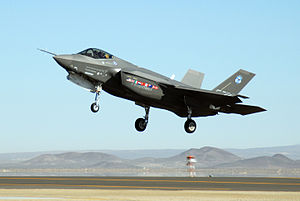
An F-35 Joint Strike Fighter, marked AA-1, lan...Image via Wikipedia

Tomgram: William Astore, You Have No Say About Your Military
Posted by William Astore at 10:50am, March 18, 2010.

When was the last time you saw the headline, “Cost of [Pentagon-weapons-system-of-your-choice] halved”? Probably never. Still, the thought came to mind when this recent Associated Press headline caught my eye: “Pentagon: F-35 fighter jet cost doubles.”

Here’s the story behind it: Since 2001, when an F-35 Joint Strike Fighter was expected to cost an already hefty $50 million, the plane’s cost has soared into the stratosphere (despite the fact that the aircraft itself has barely left the ground). The estimated cost today is $113 million per plane. Yes, that’s per plane. This supposed future workhorse of the U.S. military is now priced like the planet’s most precious gem. It’s also 2 ½ years behind schedule. Keep in mind that the Marines, the Air Force, and the Navy are planning to buy a combined 2,450 of them for what’s now an eye-popping $323 billion. And if you think the costs are likely to stay in the $113 million range, given the history of Pentagon cost overruns, then I have a nice little national security bridge to Brooklyn I think the U.S. public might love.

In other words, if all goes well from here (an unlikely possibility), a single future weapons system is now estimated to cost the American taxpayer almost one-third of what the Obama administration’s health-care plan is expected to cost over a decade. You could even think of the Pentagon’s weapons procurement process as the health-care system of the national security state. Its costs just never stop rising. In fact, the Government Accountability Office pegs major weapons systems cost overruns since 2001 at $295 billion, another near third of the cost of the health-care bill supposedly coming to a vote this week.

And here’s what’s remarkable: You barely hear about such overruns. They’re almost never front-page headline news, even though the money’s being taken from not-so-deep taxpayer pockets. And when truly terrible news, as with the F-35, comes in, all that happens in Washington is that a few politicians mutter a little. John McCain, for example, offered this less than stirring quote on the F-35: “The taxpayers are a little tired of this. I can’t say that I can blame them”; and an irritated Senator Carl Levin, chairman of the Senate Armed Services Committee, said: “We cannot sacrifice other important acquisitions in the DOD [Department of Defense] investment portfolio to pay for this capability.” (Bet you didn’t even know that future weapons were part of a Pentagon “investment portfolio.”) In the case of Secretary of Defense Robert Gates, he’s planning to hold back $614 million in “performance bonuses” from the plane’s lead contractor Lockheed Martin. (And you thought only bankers and financial wheeler-dealers got performance bonuses!) But it’s striking that there are no tea party movements out in the streets of America demanding our money back or claiming that we’re going to be broken by this.

Here’s an American reality: the Pentagon is our true welfare state, the weapons makers our real “welfare queens,” and we never stop shoveling money their way. Somebody should raise a few tough questions about the Pentagonization of our country and its finances. Fortunately, TomDispatch has retired Lt. Col. William Astore, historian and regular contributor to this site, to take on the task. Tom

The Pentagon Church Militant and Us
The Top Five Questions We Should Ask the Pentagon
By William J. Astore

When it comes to our nation’s military affairs, ignorance is not bliss. What’s remarkable then, given the permanent state of war in which we find ourselves, is how many Americans seem content not to know.

There are many reasons for this state of affairs. Our civilian leaders encourage us to be deferential toward our latest commander/savior, whether Tommy Franks in 2003, David Petraeus in 2007, or Stanley McChrystal in 2010. Our media employs retired officers, most of them multi-starred generals, in a search for expertise that ends in an unconditional surrender to military agendas. A cloud of secrecy and “black budgets” combine to obscure military matters, ranging from global strategy to war goals to weapons procurement. The taxpayer, forced to pony up about one trillion dollars yearly to fund our military, national security infrastructure, and wars, is sent a simple message: stay clear and leave it to the experts in uniform.

The powerlessness of ordinary Americans in military matters is no accident. Recall the one-word reply -- “So?” -- Dick Cheney offered in March 2008, when asked to comment on popular opposition to the war in Iraq. The former vice president was certainly far blunter than Washington usually is, and for that we may owe him a measure of thanks. By highlighting the arrogant dismissiveness of Washington’s warrior-elite when it comes to American public opinion, he revealed more than he intended.

Time for Vatican II at the Pentagon

If military power is the church at which we worship and the Pentagon is our American Vatican, then it is desperately in need of the equivalent of Vatican II which, in the early 1960s, opened the Catholic Church to greater participation by the laity, a vitally important change in ethos. Instead of continuing to pray at the altar of their particular services, we need our Pentagon “priests” to turn to the laity -- us -- and seek our input and sanction. Instead of preaching in unintelligible Pentagonese, with its indecipherable acronyms, secret doctrines, and spidery codenames, it’s long past time for them to talk to us in a language that reasonably informed adults can understand.

Think about this: last year, our country held innumerable public hearings on health-care reform. Congress continues to fight about it. It’s constant news. There’s a debate alive in the land. All this for a program that, in ten years, will cost the American people as much as defense and homeland security cost in a single year.

Yet runaway defense budgets get passed each year without a single “town hall” meeting, next to no media coverage, and virtually no debate in Congress. Indeed, you’d think each Pentagon budget was an ex cathedra pronouncement, given the way Congress genuflects before them and Americans accept them without so much as a peep of protest.

Those “Crazy” Kiwis

Imagine, for a moment, if Pentagon officials, supposedly toiling in our name, actually condescended to ask us for our thoughts. What do we think about global military strategy, garrisoning the planet, the ways in which our forces are structured, and how, where, and for what they should be deployed abroad?

Sound crazy? Here in the U.S.A. it most distinctly does, but not to the citizens of New Zealand. A Kiwi friend of mine recently sent me “Defence Review 2009,” a publication of New Zealand’s Ministry of Defence (MoD). And catch this: it includes a survey soliciting the advice of ordinary New Zealanders with respect to military affairs. It actually asks for the counsel of civilians on a “top ten” list of questions whose topics are remarkably comprehensive, including what the priorities of the country’s Defence Force should be, both now and in the future. Citizens can even present their views on military matters at a public hearing attended by MoD representatives, all in the name of public consultation. And the Defence Minister responds to the people in clear English sans the cobwebs of jargon that typically entangle our military pronouncements.

In case you haven’t noticed, here in the U.S.A., requests from the Pentagon for citizen feedback aren’t flooding our email boxes. So I thought -- since no one in that five-sided fortress on the Potomac has asked a thing of me -- the least I could do was ask a few questions on my own. Here, then, is my own top-five list of questions that we, the American people, should ask the Pentagon, even if none of its officials want to hear from us. Maybe they’re a tad more pointed than those in the Kiwi survey, but that shouldn’t be surprising. After all, they’ve been a long time in coming.

1. Our military is supposed to be a means to an end: national security. Due to its immense size and colossal budget, has our military not become an end as well as means?

2. In World War II, Americans could explain “Why We Fight” in part because the government provided a clear and compelling rationale for war. Why are the goals of today’s wars so opaque to most Americans?

3. If our military provides us with our way of “nation building” abroad, won’t countries and peoples be more likely to copy our military ways and weaponry than our democratic teachings?

4. America is facing painful budgetary belt tightening. Why is the military immune?

5. Why does “support our troops” seemingly end when they leave the service, leading us to tolerate such inequities as an unemployment rate of 21% for young veterans?

Keep in mind that there are 10, 20, 30 more questions where those five came from -- and our military badly needs to hear and respond to them all.

Every recruit is taught to stretch, to go the extra mile, to push until you can go no further. Our military needs some stretching and push-back: this time, from us. Unfortunately, most of us don’t think our opinions matter when it comes to our military -- unless, that is, they consist solely of slavish adoration. The fact is most of us are detached from military affairs precisely because we know in our hearts that the Pentagon serves its own needs, that it may be interested in listening in on us, but certainly not in listening to us.

Challenge the Pentagon Church Militant

Kiwis have the reputation of being practical types with an admirable dash of humility, and I like to think that their Ministry of Defence solicits the views of its citizenry not just because it’s required by statute, but because their officials don’t believe they have a monopoly on good ideas.

Perhaps the MoD recognizes as well the difficulty military professionals have in thinking outside the box. Despite its gargantuan size and its endless advisory committees and boards, our Department of Defense is, in essence, a well-insulated church of likeminded believers, administered by tightly-wound power-brokers. It sees the world only as an arena of, and for, conflict. Wherever it looks, even within its own ranks, it sees rivals and enemies. It cannot help dividing the world into believers and heretics, friends and foes.

And it’s true that the world is a dangerous place. The problem is: the Pentagon is part of that danger. Our military has grown so strong and so dominates our government, including its foreign policy and even aspects of our culture, that there’s no effective counterweight to its closeted, conflict-centered style of thinking.

In fact, the Pentagon’s heft gives new meaning to the term “full spectrum dominance” and helps explain the lack of change in war policy since the 2008 elections. A vote that constituted an unmistakable call to end our wars in Iraq and Afghanistan -- and so lessen the military’s influence -- has led only to fresh war “surges” and mushrooming Pentagon budgets. And yet, as the Pentagon charges forward, debate is nearly nonexistent and Congress can muster just 65 votes for a resolution to curtail the endless conflict in Afghanistan.

It’s shameful that only a so-called far left congressman like Dennis Kucinich has enough sense (and guts) to insist on Congressional debate about our forever-war in Afghanistan. Equally shameful: that Congress allotted only three hours to that debate on matters of life, death, and even financial well-being. Do we really need reminding that debate makes democracy stronger? Evidently so. Take it from me as a retired Air Force officer: our troops won’t be demoralized by more debate and greater citizen participation.

Let’s face it, all of this represents a long-term sea change in American consciousness. Sadly, the old idea of the citizen army is dead, and because of this, most of us lack any direct connection to the military (and seemingly could care less). In the name of safety, security, and solidarity, we’ve buttoned our lips. We worship, but don’t partake.

Centuries from now, historians will look back on American history and wonder how so many gave away so much to so few. It should be our right to have a say in what defines the “defense” of our country. That right has been surrendered to the few. Our future may depend on genuine input from the many.

How about it? Are you ready to challenge the Pentagon church militant? Or are you content to mouth the usual catechism, while continuing to dump billions each week into the collection basket?

Citizens of courage will surely choose the path of challenge.

William J. Astore is a retired lieutenant colonel (USAF) and TomDispatch regular. He currently teaches history at the Pennsylvania College of Technology and may be reached at wastore@pct.edu.

Copyright 2010 William J. Astore


Reblog this post [with Zemanta]